


Research
Disentangling Age, Time, and Cohort Effects in Income Inequality: A Proxy Machine Learning Approach
David Bruns-Smith, Emi Nakamura, Jón Steinsson
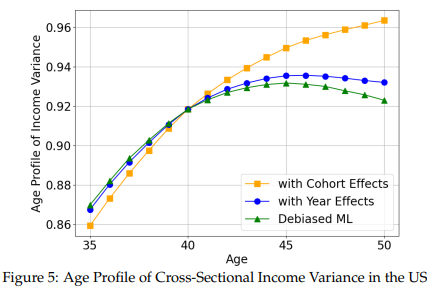
Earlier research has concluded that the cross-sectional variance of income rises steeply with age. The methods used to reach this conclusion are sensitive to the age-time-cohort identification problem. We propose a new proxy-based (debiased) machine learning approach to solve this problem. We estimate substantially less steep age profiles for the cross-sectional variance of income.
Beyond the Taylor Rule
Emi Nakamura, Venance Riblier, Jón Steinsson
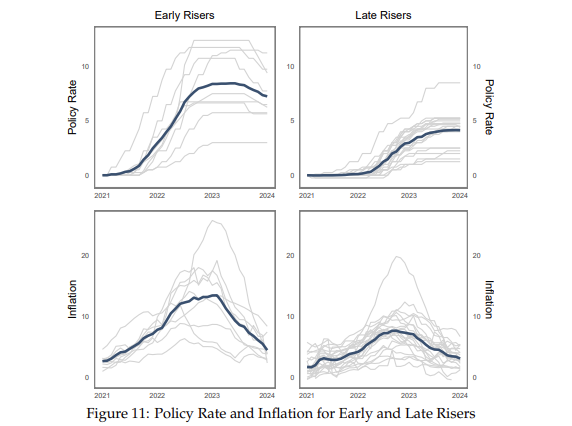
The Taylor rule fit reasonably well between 1987 and 2008, but hasn’t fit well since. Countries with relatively poor credibility of monetary policy raised rates more after Covid but experienced more inflation. Countries with more credibility were able to look through the post-Covid inflation to a greater extent. It is optimal for central banks with strong credibility to partly look through supply shocks. Concerns about indeterminacy are overblown.

Macroeconomic Effects of UI Extensions at Short and Long Durations
Miguel Acosta, Andreas Mueller, Emi Nakamura, and Jón Steinsson
The effect of UI extensions on unemployment are small when pre-extension durations are already long. These effects are quite a bit larger when pre-extension durations are smaller.

The Macroeconomic Consequences of Exchange Rate Depreciations
Masao Fukui, Emi Nakamura, and Jón Steinsson
Quarterly Journal of Economics, 140(4), 3015-3065, November 2025.
Regime-induced exchange rate depreciations are strongly expansionary. Net exports fall (ruling out an export led boom) and nominal interest rates rise (ruling out a monetary expansion). To explain these findings, we build a financially driven exchange rate model (FDX model) with a strong foreign credit channel. Our model is also consistent with exchange rate disconnect and the Mussa facts.

A Plucking Model of Business Cycles
Stéphane Dupraz, Emi Nakamura, and Jón Steinsson
Journal of Monetary Economics, 152, 103766, June 2025
US unemployment strongly displays the asymmetry that increases in unemployment are followed by decreases of similar amplitude, while the amplitude of the increase is not related to the amplitude of the previous decrease. This fact favors the plucking view that recessions are shortfalls below a maximum level rather than fluctuations around a natural rate:

When Did Growth Begin? New Estimates of Productivity Growth in England from 1250 to 1870
Paul Bouscasse, Emi Nakamura, and Jón Steinsson
Quarterly Journal of Economics, 140(2), 835-888, May 2025
Productivity growth began in England in 1600, well before the Glorious Revolution. This suggests growth may have contributed to causing 17th century liberal reforms in England

Learning about the Long Run
Leland Farmer, Emi Nakamura, and Jón Steinsson
Journal of Political Economy, 132(10), 3334-3377, October 2024.
Bayesian learning can explain all prominent forecast anomalies by professional forecasters and deviations from the expectations hypothesis of the term structure.

Women, Wealth Effects, and Slow Recoveries
Masao Fukui, Emi Nakamura, and Jón Steinsson
American Economic Journal: Macroeconomics, 15(1), 269-313, January 2023.
As female employment has converged towards male employment, the growth rate of female employment has slowed. This has led business cycle recoveries to become slower.

The Slope of the Phillips Curve: Evidence from U.S. States
Jonathon Hazell, Juan Herreno, Emi Nakamura, and Jón Steinsson
Quarterly Journal of Economics, 137(3), 1299-1344, August 2022.
Evidence from new state-level CPI data suggests the slope of the Phillips curve is small and was small during the 1980s. Volcker disinflation was mostly due to rapid downward shift in inflationary expectations.
Appendix — State Level CPI Data (BETA) -- ReadMe for State Level CPIs

The Gift of Moving: Intergenerational Consequences of a Mobility Shock
Emi Nakamura, Jósef Sigurdsson, and Jón Steinsson
Review of Economic Studies, 89(3), 1557-1592, May 2022.
An volcanic eruption caused a third of the houses in a town to be covered by lava. People living in these houses were much more likely to move away permanently. For the children living in these houses, we estimate that being induced to move by this “lava shock” dramatically raised lifetime earnings and education.

Housing Wealth Effects: The Long View
Adam Guren, Alisdair McKay, Emi Nakamura, and Jón Steinsson
Review of Economic Studies, 88(2), 669-707, March 2021.
The housing wealth elasticity was no higher in the 2000s than before. The important role of housing in the 2000s boom-bust was due to the large movements in house prices as opposed to an unusually large housing wealth elasticity. We find no boom-bust asymmetry in the housing wealth elasticity.
Local House Price Sensitivity Estimates -- Online Appendix -- Replication Files

What Do We Learn From Cross-Regional Empirical Estimates in Macroeconomics
Adam Guren, Alisdair McKay, Emi Nakamura, and Jón Steinsson
NBER Macroeconomics Annual 2020, 175-223.
Cross-Regional estimates contain both partial equilibrium effects and local general equilibrium effects. Estimates of local fiscal multipliers can be used to isolate the partial equilibrium effects. Also, since housing supply elasticities are more dispersed in the long-run than short-run, cities with low long-run housing supply elasticities can have larger construction booms in the short run.

New Evidence on the Cyclicality of Employer-to-Employer Flows from Canada
Alice Nakamura, Emi Nakamura, Kyle Phong, and Jón Steinsson
American Economic Association Papers and Proceedings, 109, 456-460, May 2019.
Canadian evidence indicates that employment-to-employment flows are highly pro-cyclical. This implies that recessions retard reallocation of workers across jobs.
Replication Files. Companion paper: Worker Reallocation over the Business Cycle: Evidence from Canada

The Elusive Costs of Inflation: Price Dispersion during the U.S. Great Inflation
Emi Nakamura, Patrick Sun, Jón Steinsson, and Daniel Villar
Quarterly Journal of Economics, 133(4), 1933-1980, November 2018.
Evidence on the size of price changes indicates that price dispersion was no higher during the Great Inflation than in recent years. This suggests that the standard New Keynesian analysis of the welfare costs of inflation is wrong and its implications for the optimal inflation rate need to be reassessed.
Appendix -- Slides -- ELI Concordance -- Replication Material

High Frequency Identification of Monetary Non-Neutrality: The Information Effect
Emi Nakamura and Jón Steinsson
Quarterly Journal of Economics, 133(3), 1283-1330, August 2018.
Nominal and real rates respond one-for-one to FOMC announcements, while expected inflation responds very little. Expectations of growth rise after surprise monetary tightenings suggesting information effects are important.
Appendix -- Slides -- Replication Files -- Policy News Shocks (original sample period)
Policy News Shocks constructed by Acosta and Saia for an updated sample period may be found here.

Identification in Macroeconomics
Emi Nakamura and Jón Steinsson
Journal of Economic Perspectives, 32(3), 59-86, Summer 2018.
Often the causal effects we can estimate don’t answer the question we are interested in. But causal effects estimates can also be used to distinguish between competing structural models and in that way indirectly shed light on questions of interest.

The Discounted Euler Equation: A Note
Alisdair McKay, Emi Nakamura, and Jón Steinsson
Economica, 84, 820-831, October 2017.
The discounted Euler equation mutes the extent to which far future changes in interest rates affect current output and inflation. At the ZLB, the discounted Euler equation makes ‘deflationary death spirals’ less likely.

Informational Rigidities and the Stickiness of Temporary Sales
Eric Anderson, Benjamin Malin, Emi Nakamura, Duncan Simester, and Jón Steinsson
Journal of Monetary Economics, 90, 64-83, October 2017.
While most price changes are temporary sales, retail prices respond to a wholesale cost increase entirely through the regular price. Temporary sales are governed by complex contingent contracts between manufacturers and retailers, determined substantially in advance.

Growth-Rate and Uncertainty Shocks in Consumption: Cross-Country Evidence
Emi Nakamura, Dmitriy Sergeyev, and Jón Steinsson
American Economic Journal: Macroeconomics, 9(1), 1-39, January 2017.
Major economies experienced large growth-rate and uncertainty shocks during the 20th century. These shocks can help explain the high return on stocks relative to bonds.

The Power of Forward Guidance Revisited
Alisdair McKay, Emi Nakamura, and Jón Steinsson
American Economic Review, 106(10), 3133-3158, October 2016.
Standard models imply that far future interest rate changes have implausibly large effects on output and inflation. Allowing for precautionary savings and borrowing constraints can mute these effects, yielding a more plausible model of the monetary transmission mechanism